
How to play Murdoku: the rules, explained step by step
Murdoku is the puzzle book that turned murder into a logic problem: a collection of cases you solve with pure deduction, no hidden clues, no tricks. If you have just opened it and can’t see how you are supposed to find the killer with so little to go on, this article is for you. By the end of it you will have solved your first case.
What Murdoku is
It was created by Manuel Garand in 2016 and has since become a phenomenon in several countries, Spain above all: Murdoku: 80 Murder Mystery Logic Puzzles was followed by Volume 2: Back in Time, and Volume 3: Around the World arrives on 27 October 2026. The name says it all: it is a cross between a sudoku and a detective story. Each case fits on a double page, and you don’t need to know anything about the previous cases to solve it.
 Murdoku: 80 Murder Mystery Logic Puzzles
The book to start with, by Manuel GarandSee it on Amazon →
What you are looking at
Every case has two parts:
The floor plan. A house, a shop, any setting at all, seen from above and drawn over a grid. The plan is divided into named rooms (kitchen, living room, bedroom…), and inside the rooms there is furniture: beds, chairs, tables, plants, shelves. Windows and doors sit on the outer walls.
The suspect cards. One portrait per person and a single sentence each: where they say they were at the time of the murder. The important words are in bold. One of the cards belongs to the victim.
Underneath, an empty grid to record where everyone was, and a line to write the murderer’s name.
The three rules
The whole game fits in three sentences.
1. One person per row and per column. Just as every number in a sudoku appears once per row and once per column, here every person occupies exactly one cell, and every row and every column holds exactly one person. The victim counts too: they are placed like everyone else.
2. Some furniture you can be on, some you can’t. A person can be on a bed, in a chair or on a sofa. Nobody can be on a table, a plant or a bookshelf: next to them, yes; on top of them, no. The cells taken up by that kind of furniture are out of the game from the start.
3. The murderer is whoever was left alone with the victim. Once everyone is placed, look at which room the victim is in. That room holds exactly two people: the victim and the murderer. There is no motive to deduce and no weapon to find; geometry names the culprit.
Every statement is true. Nobody lies. That is the deal the game makes with you, and it is what turns it into a logic problem rather than a guessing game.
How to read a statement
The sentences look vague the first time, but each one is a very precise constraint. These are the kinds you will meet again and again:
| The statement says | What it means on the grid |
|---|---|
| “I was on a bed” / “in a chair” | Occupies one of that piece of furniture’s cells (and only that piece). |
| “I was in front of a window” | Occupies the cell directly inside that window. |
| “I was in the living room” | Any free cell in that room. |
| “I was next to the table” | A cell that touches the table on one side: above, below, left or right. Diagonals don’t count. |
| “I was alone in the kitchen with Marc” | That room holds exactly two people, and she is one of them. |
| “I was not in the bedroom” | Rules out every cell in that room. Negations are the sneakiest: they seem to say little and are sometimes the key. |
| “The victim. I was alone with the murderer” | Rule 3, written on a card. The victim is also placed in a cell like anyone else. |
The skill in Murdoku lies in combining two or three of these constraints: each one on its own leaves several possible cells, but together they usually leave one.
A small case, solved from start to finish
Let’s do it with a made-up 4×4 case, smaller than the ones in the book but with exactly the same rules. The columns are A to D; the rows, 1 to 4. Columns A and B are the kitchen; columns C and D, the living room. On the top wall of the living room, above cell C1, there is a window.
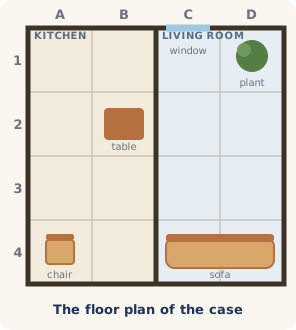
Four people: Victor (the victim), Aina, Biel and Carla. Their statements:
- Aina: “I was sitting in the chair.”
- Biel: “I was in front of the window.”
- Carla: “I was next to the table, in the kitchen.”
- Victor: “The victim. I was alone with the murderer.”
Step 1 — Start with the most specific statement. There is only one chair on the whole plan, at A4. Aina is at A4. With that, we cross out row 4 and column A for everyone else.
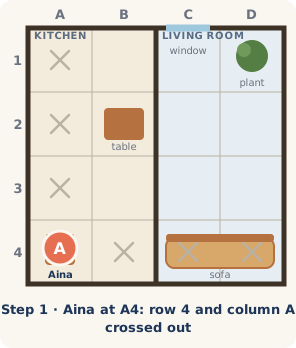
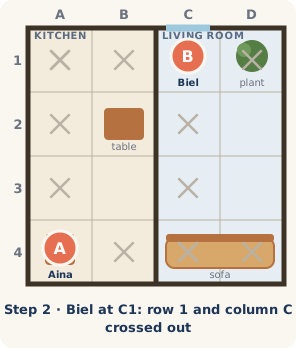
Step 2 — The window. There is only one window, and the cell in front of it is C1. Biel is at C1. Cross out row 1 and column C.
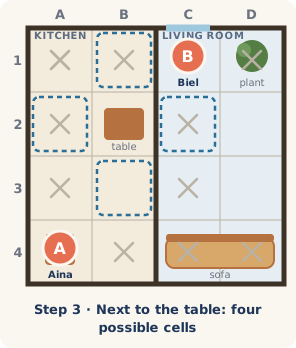
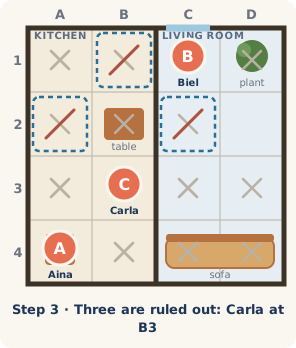
Step 3 — Combine statements. Carla was next to the table, which sits at B2. The cells touching the table are B1, A2, C2 and B3. Now apply what we already know: B1 is in row 1 (taken by Biel); A2 is in column A (taken by Aina); C2 is in the living room, and Carla says she was in the kitchen. Only B3 is left. Notice that Carla’s statement alone allowed four cells; Aina’s and Biel’s cut it down to one.
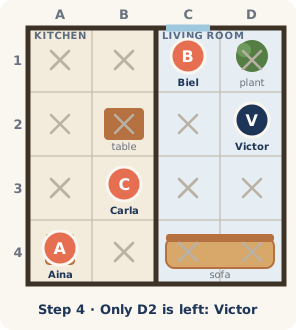
Step 4 — The victim. Row 2 and column D are still free. Victor has to be at D2, which is an ordinary living-room cell (the plant is at D1, not D2).
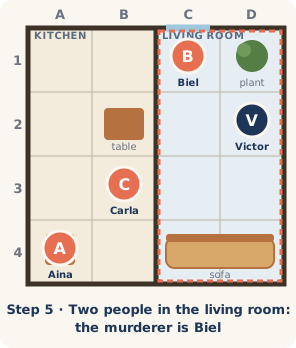
Step 5 — Who was left alone with the victim? Victor is in the living room. So is Biel, at C1. Aina and Carla are both in the kitchen. The victim’s room holds exactly two people, and the murderer is Biel.
That is all of Murdoku. The cases in the book have more people, more rooms and furniture that spans several cells, but there is no new rule: only more constraints to combine.
First-week mistakes
- Placing someone “because it fits”. If a cell is possible but another one is possible too, you can’t place that person yet. Move on to another statement and come back later.
- Forgetting to cross out. Every placement removes a whole row and a whole column for everyone else. If you don’t write it down, the remaining statements look far more ambiguous than they are.
- Reading “next to” as “near”. It means sharing a side, not a diagonal and not two cells away.
- Suspecting the character. The murderer is not the one who looks guilty or says something odd. It is whoever ends up alone with the victim. Nothing else.
Once the first case comes out without help, try timing yourself on the next one: you will find the slow part is not the logic but the order in which you tackle the statements. That is what the next article is about: seven tips for the hard cases.
Try it yourself
Tap a suspect, then the cell where they were. Once all four are placed, the board tells you who the murderer is.
Quick questions
How many rules does Murdoku have?
Three: one person per row and per column; some furniture can be occupied (bed, chair, sofa) and some can only be stood next to (table, plant, shelf); and the murderer is whoever is left alone with the victim in their room.
Do you have to guess?
No. Every statement is true and every case has exactly one solution, reached by combining them. If you find yourself guessing, there are two statements you haven't crossed yet.
What does 'next to' mean in Murdoku?
That the cell touches the piece of furniture on one of its four sides. Diagonals don't count, and neither does two cells away.
Is the victim placed on the grid too?
Yes. The victim occupies a cell like any other character and counts for the one-per-row-and-column rule. In easy cases their position is given; in hard ones it has to be deduced.
Can you play Murdoku without the book?
With the same rules, yes: Culpable is a free crime sudoku, in the browser and on Android, with unlimited cases and a daily case. It is not Murdoku and has no connection to its authors.