
7 tips for solving the hard Murdoku cases
The first Murdoku cases solve themselves: each statement leaves one cell and you place people one after another. Around the middle of the book, that stops. You read every card, none of them gives you a certain cell, and the grid stays blank while you stare at the floor plan as if it might confess.
It isn’t that the hard cases use new rules. They are the same three as always (one person per row and column, furniture you can and can’t be on, the murderer is whoever is left alone with the victim). What changes is that no single statement is enough on its own: you have to combine them, and there is a good order and a bad order for doing that. These seven tips are that order. If the rules are still hazy, start with how to play Murdoku.
1. Read every statement before placing anyone
It sounds obvious and almost nobody does it. The temptation is to read the first card, find the cell, write the name and move on. In the easy cases it works; in the hard ones it leads you to put someone in a “possible” cell that later turns out to be the wrong one, and to redo half the grid.
Read them all. As you go, sort them mentally into three piles: the ones that name a specific piece of furniture or a window (strong), the ones that name a room or an adjacency (medium), and the negations or the “alone with” ones (apparently weak). Start with the first pile. Keep the third: it is what solves the ending.
2. Count the furniture
“I was on a bed” seems imprecise until you count: how many beds are on the plan, and how many cells does each one cover? A double bed is two cells; if the house has two beds, that person has four possible cells, not “the whole bedroom”. Same with “in front of a window”: count the windows and note the cell inside each one.
Do it in writing. For each strong statement, jot the cells it allows in the margin (A4, B2, B3…). When a list has one item, that person is placed. When it has two, they are a candidate for technique 7.
3. Actually cross out
Each placed person removes their row and their column for everyone else. In the advanced cases this is where most deductions come from, and it only works if you write it down. With a pencil, cross the cells of the row and the column every time you place someone. After three placements, a statement that allowed six cells has usually shrunk to one, without you doing anything but crossing out.
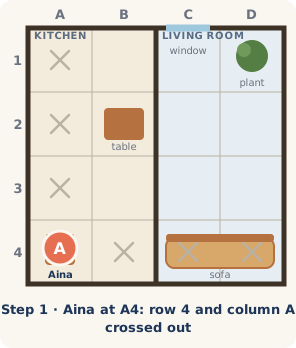
A practical tip: also mark the cells taken by furniture nobody can be on (tables, plants, shelves) before you start. They are dead cells, and seeing them crossed out from the beginning saves a lot of checking.
4. “Alone with” statements fix a room’s headcount
“I was alone in the guest room with Bruno” says two things: that she and Bruno are in that room, and that nobody else is. The second part is the one people forget. If the guest room has five free cells, three of them just lost every possible occupant, and that affects every other statement that mentioned the room.
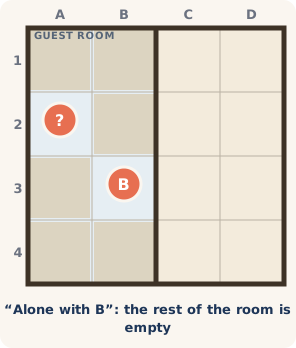
Keep count the other way round too: the victim’s card says they were alone with the murderer, so the victim’s room will hold exactly two people. If you already know which room the victim is in, anyone who has to be there is a suspect, and anyone already placed elsewhere is ruled out.
5. Cross two statements that talk about the same place
When two people mention the same room or the same piece of furniture, their statements constrain each other through the row-and-column rule. If Hugo and Lea both have to be “in the dining room” and the dining room has three free cells, two of them in the same row, then one of the two people takes the third cell and the other takes one of the first two. Any other placement that touches that row settles it.
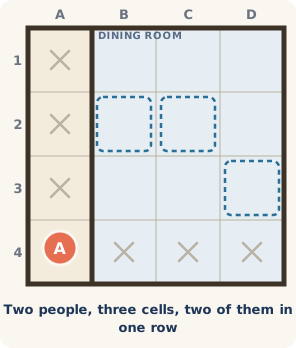
This is the step that most resembles a real sudoku: you don’t look at a person, you look at a group of cells and ask who can occupy them. Switching from “where is Hugo?” to “who can be in this cell?” unlocks a lot of cases.
6. Negations solve the ending
“I was not sitting in a chair. I was not in the master bedroom.” At the start of a case this card is useless: it rules things out, but the whole plan is still available. At the end, with six people placed and three cells free, the same card usually points to exactly one. That is why tip 1 said to keep them.
How to use them: when you run out of strong statements, look at the cells that are still free, and for each unplaced person ask which of those cells their negation forbids. Very often someone is left with exactly one.
7. When everything else fails: assume, and look for the contradiction
Some cases reach a point where no statement decides anything. Two people with two possible cells each, and everything else waiting on them. Then you make a hypothesis: put one of them in one of their two cells, very lightly in pencil, and keep deducing as if it were true. One of two things happens: either you hit a contradiction (someone is left without a cell, two people in the same row, a room with three people when it should have two), in which case you know that person is in the other cell; or the whole case resolves and you are done.
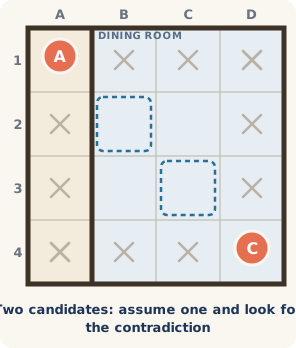
Two warnings. Only do it with people who have two candidates, not five, because with five branches you get lost. And pick the person whose placement affects the most others (the one sharing a row or a room with the most unplaced people): the contradiction arrives sooner.
Most cases have a chain of direct deductions that solves them without assuming anything, though in the last ones that chain sometimes runs through a crossing of three or four statements that is very hard to see, and the hypothesis gets there first. And there are a few, the genuinely hard ones, where that direct path doesn’t exist and assuming is the only way forward. The hypothesis isn’t cheating: it is the most advanced of the four techniques this game has, and knowing when to use it is what separates a forty-minute case from a ten-minute one.
 Murdoku Volume 2: Back in Time
If you know the first one by heart: 80 new cases across five erasSee it on Amazon →
The one-sentence summary
Read everything, start with the specific, cross out without exception, count how many people fit in each room, and save the negations and the hypothesis for the end. With that, the cases in the second half of the book stop being a wall and become what they are: the same game with more pieces.
If you want to practise these techniques on cases that never run out, every case in Culpable is rated by the hardest technique it needs, and the hint system explains what the next step is instead of handing you the answer. Each of the four techniques has its own guide inside the game: the statement that says it all, ruling out until one is left, crossing two statements and assuming and reaching a contradiction.